

MQTT protocol
Topic and payload behavior, plus the durable mobile measurement-sync pipeline.
The canonical MQTT contract is generated from root asyncapi.yaml and rendered in the MQTT API reference. This page explains how current clients use that contract; the generated reference wins if field-level details differ.
Experiment ingestion topic
experiment/data_ingest/v1/{experimentId}/{sensorType}/{sensorVersion}/{sensorId}| Segment | Meaning |
|---|---|
experiment/data_ingest/v1 | Versioned fixed prefix routed by the AWS IoT rule. |
experimentId | Experiment receiving the measurement. |
sensorType | Device family, such as multispeq. |
sensorVersion | Hardware/firmware family version used for routing and compatibility. |
sensorId | Device identifier. |
A transitional legacy shape with a trailing {protocolId} segment remains routed for already-fielded mobile builds; it is removed once those roll over. New publishers use the shape above.
Treat every segment as routing data: do not include / inside a value. AWS IoT policies scope which topics a credential may publish, so a structurally valid topic can still be unauthorized.
Delivery semantics
MMI and the mobile Paho transport publish with MQTT QoS 1. Success means the broker acknowledged the message, not that the Databricks transformation is already visible. QoS 1 is at-least-once; retries can produce repeat delivery and downstream code must retain enough identity/provenance to investigate or deduplicate it.
MMI uses AWS IoT's native SDK and X.509 paths. Mobile uses an AWS-signed WebSocket URL and temporary credentials. These authentication flows are not interchangeable.
Payloads
Current mobile workbook measurements include a version ID and a run ID shared across that workbook attempt, as well as the result's protocol ID, user, timestamp, timezone, questions, macros, and annotations. A questions-only upload on the lean topic carries the workbook version and run IDs but no protocol or device result. The general MQTT contract leaves these fields optional for publishers outside the mobile workbook flow and for older payloads. The large sample field is gzip-compressed and base64-encoded; _sample_encoding: "gzip+base64" tells Silver processing to decompress it.
MMI currently publishes the analyzed single-SPAD result produced by DeviceManager, with interactive plant_metadata. Continuous mode also adds an ISO timestamp. This development payload is useful for testing the route but is not a complete example of the mobile production payload.
The AWS IoT rule adds the original topic and authenticated client ID before it writes Kinesis/S3. Do not let a self-reported JSON device ID substitute for broker-authenticated identity in security decisions.
Mobile measurement sync
The mobile app uses a SQLite transactional outbox so a measurement survives restarts and offline periods.
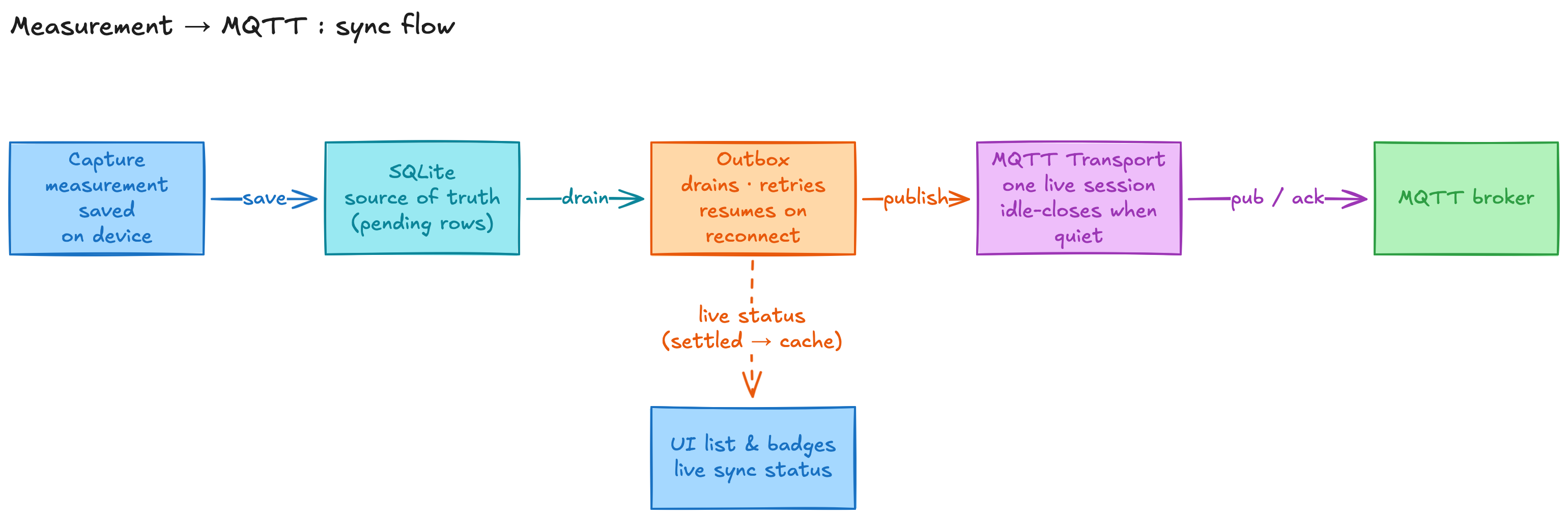
Status and retry model
| Status | Meaning |
|---|---|
pending | Durable locally, not yet acknowledged. |
failed | Delivery exhausted retries or hit a terminal error; eligible for user retry. |
successful | QoS 1 PUBACK received. |
The current constants allow eight concurrent rows and use waits of 1, 4, and 15 seconds, giving up to four attempts. The transport itself does not run a background reconnect loop. It lazily opens one session on demand, rejects in-flight work on disconnect, and closes after 30 seconds idle. Each publish also has a 30-second acknowledgement timeout.
PublishError, Timeout, and Disconnected are retryable. CredentialError is terminal because repeating the same invalid authorization cannot heal it. Pending and failed rows are rehydrated at construction and on foreground, with a cooldown to collapse duplicate lifecycle triggers. The queue pauses while React Query's online manager reports offline.
Reactive UI path
The outbox exposes aggregate, per-row, and settled-burst subscriptions. outbox-to-query-cache-bridge.ts throttles settled bursts before surgically patching React Query lists and counts, avoiding a database reread and render storm for every PUBACK. The composition root stores the transport/outbox graph on globalThis so React Native Fast Refresh cannot leave duplicate queues publishing the same rows.
Current module map
| Concern | Path under apps/mobile/src |
|---|---|
| SQLite source of truth | shared/db/schema.ts, shared/db/measurements-storage.ts |
| Outbox and tuning | features/recent-measurements/services/outbox.ts, upload-constants.ts |
| Cache bridge | features/recent-measurements/services/outbox-to-query-cache-bridge.ts |
| MQTT transport/session/auth | features/connection/services/mqtt/ |
| Composition root | shared/composition/upload.ts |
| Wide-event tracing | shared/observability/trace.ts |
For the cloud side of this sequence, read Data ingestion.